OTA or PTA? Four Things to Know Before Choosing Your Path
A woman with tongue cancer comes out of reconstructive surgery. Her cell phone rings. She instinctively answers — only to realize she can’t speak.
A 4-year-old survives a rattlesnake bite on his lower leg. As he begins to run again, his foot drags on the ground — foot drop from nerve damage.
Some recoveries are smooth, and others painstakingly slow. That’s where occupational and physical therapy professionals step up, helping patients regain their independence and mobility.
If this work speaks to you, San Jacinto College’s occupational therapy assistant and physical therapist assistant programs — OTA and PTA for short — can prepare you for these rewarding, hands-on health care fields.
Here’s what you should know before choosing between an OTA or PTA career.
1. Same goal, different focus.
“We both ensure an individual will be able to function as they go about their day,”
Dr. Kira Beal, interim OTA program director, said.
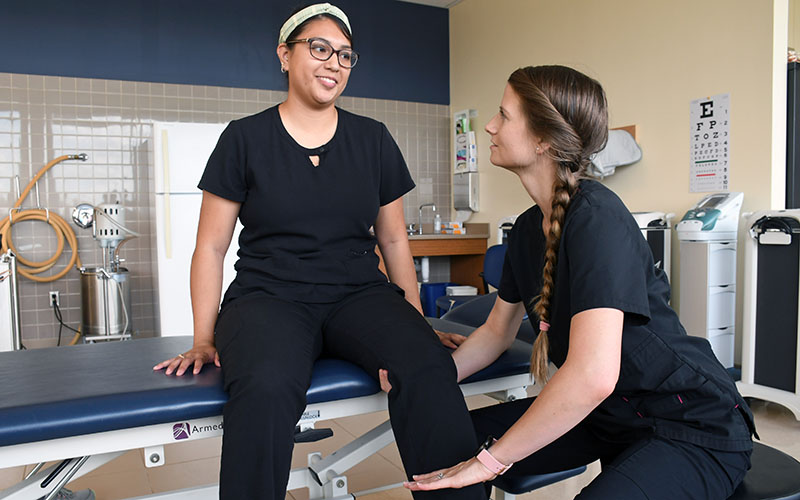
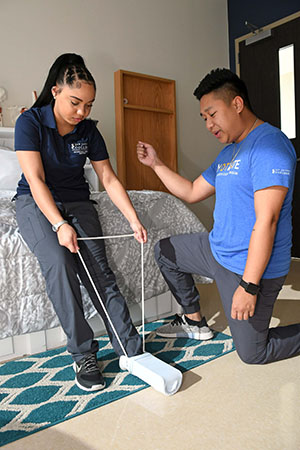
OTAs focus on daily living skills, such as dressing, bathing, cooking, driving, and using technology. PTAs focus on movement, from strength and balance to pain reduction and mobility.
An OTA might help a patient relearn how to button a shirt or safely prepare a meal. A PTA might help that same patient stand, walk, or climb stairs again.
“PTAs help people move better, while OTAs help patients live better more meaningful lives within their daily routines,” Dr. Kathryn Reeves, PTA program director, said.
2. No two days look the same.
Both OTAs and PTAs work with patients of all ages in settings from hospitals and rehabilitation centers to outpatient clinics, schools, and home health. Although they don’t evaluate patients, they conduct the full interventions.
OTAs treat a wide range of physical, cognitive, and neurological challenges throughout the day. PTAs guide patients through therapeutic exercise, functional movement, and recovery following surgery, injury, stroke, chronic illness, and more.
“Every patient is different, and no two days are alike, which keeps the work engaging and meaningful,” Reeves said.
3. Challenging work builds confidence.
These are not desk jobs. Both careers require physical stamina, critical thinking, empathy, and clear communication.
“We are health care providers and can see trauma cases just like physicians and nurses in the emergency room,” Beal said.
Students study body mechanics, safe patient handling, and ergonomics to protect themselves and their patients. Over time, they also develop clinical judgment and professional confidence.
“Some students are surprised by the depth of science, anatomy, and professionalism required — and by how impactful the role truly is,” Reeves said. “Through their education and clinical training, they develop a profound sense of autonomy to make decisions.”
4. San Jac is a great place to start.
Both San Jac programs emphasize hands-on learning from day one.
OTA students participate in weekly fieldwork experiences during their second, third, and fourth semesters, working with real clients in community settings.
“This sets us apart … students gain experience by working with clients after learning concepts, better preparing them to enter the workforce after graduation,” Beal said.
PTA students practice skills in the lab that mirror clinic environments, then complete clinical rotations that prepare them for actual patient care.
“Graduates are prepared not only to pass the licensure board exam but to thrive and excel in the industry,” Reeves said.
Conclusion:
If you’re seeking a rewarding health care career that supports work/life balance and offers advancement opportunities, OTA and PTA careers are worth a closer look.
With low tuition, only two years of study, and high employment rates, San Jac’s programs offer “a great return on investment,” Reeves said.
“And the entry-level salaries do not disappoint,” she added.
Quick Comparison
- Length: 60 credit hours (five terms)
- Median salary: $78,038*
- Program outcomes: 100% national certification exam pass rate and employment rate
*Gulf Coast region, texaswages.com
- Length: 62 credit hours (five terms)
- Median salary: $77,378*
- Program outcomes: 95% board exam pass rate and employment rate
*Gulf Coast region, texaswages.com
About San Jacinto College
Surrounded by monuments of history, evolving industries, maritime enterprises of today,
and the space age of tomorrow, San Jacinto College has served the people of East Harris
County, Texas, since 1961. The College is ranked second in the nation among more than
1,100 community colleges, as designated by the Aspen Institute and was named an Achieving
the Dream Leader College of Distinction in 2020 and 2026. As a Hispanic-Serving Institution
that spans five campuses, plus an online college, San Jacinto College serves approximately
45,000 credit and non-credit students annually. It offers more than 200 degrees and
certificates across eight major areas of study that put students on a path to transfer
to four-year institutions or enter the workforce. The College is fiscally sound, holding
bond ratings of AA+ by Standard & Poor’s and Aa2 by Moody’s. San Jacinto College is
accredited by the Southern Association of Colleges and Schools Commission on Colleges.